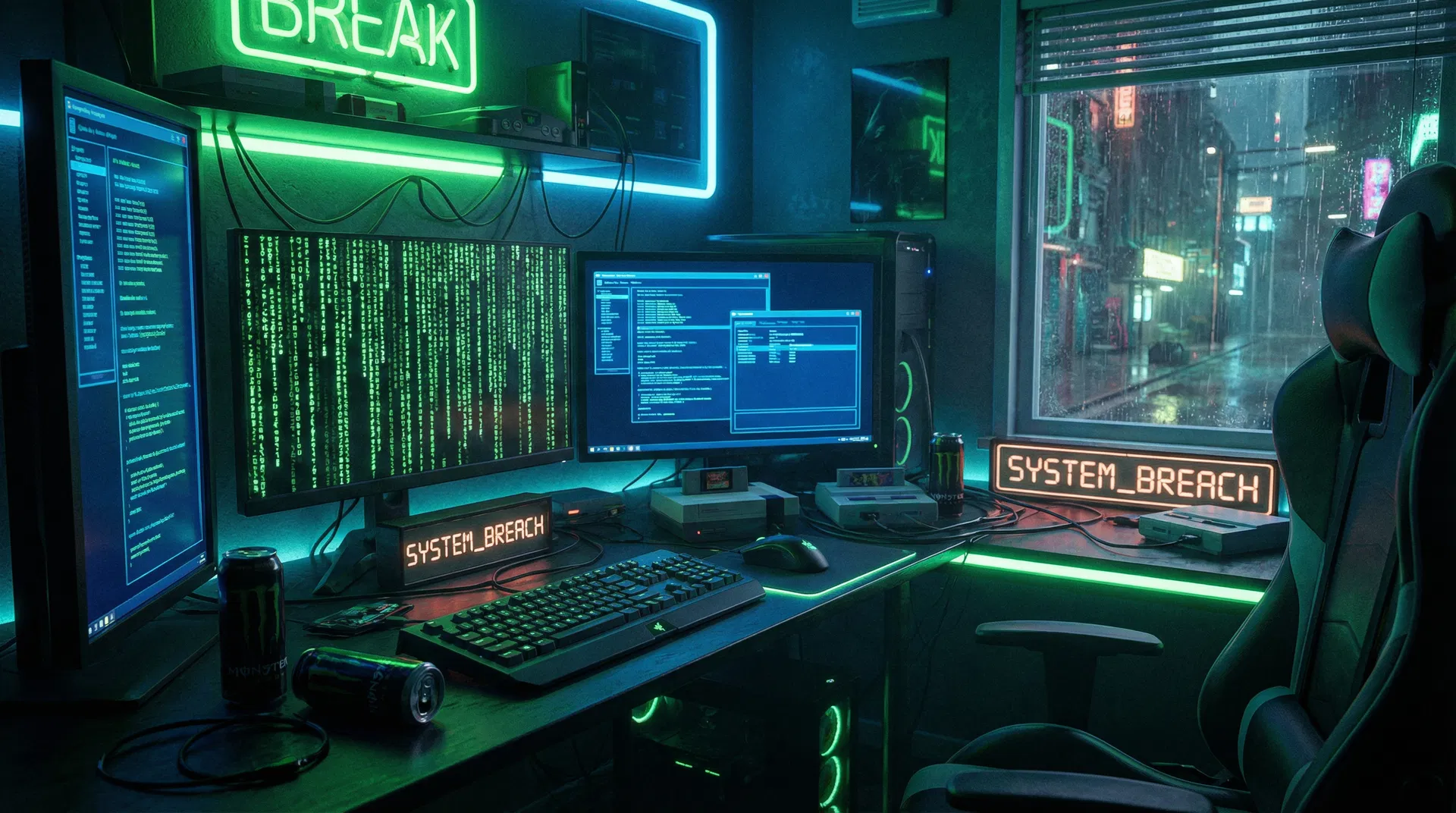
Let's be honest: We've all had that moment. You're sitting in front of your dark IDE, the mechanical keyboard is clicking like a machine gun, and for a brief second, you don't feel like a frontend developer fixing a CSS bug in Internet Explorer. No, you feel like Neo. You feel like a cyber-enhanced hacker breaking into a mega-corporation's mainframe to steal their secrets (or at least center a div).
But why is that? Why does the developer community have such a massive obsession with "Cyberpunk," "Dystopian," and "Sci-Fi" ambient music? Why do we code better when it sounds like the world outside has ended and only robots remain?
As a musician who creates these soundscapes for my channel Cyber Dreams, and as someone who spends way too much time in front of screens, I've dug into the psychology behind this phenomenon. And yes, it involves science, not just aesthetics.
The "Hackerman" Effect: It's Not Just Music, It's a Costume
First, let's address the elephant in the room (or the cyborg in the server room). We listen to this music because it makes us feel cool. Programming is, objectively speaking, mostly reading documentation and staring at error messages. It's not exactly an action movie.
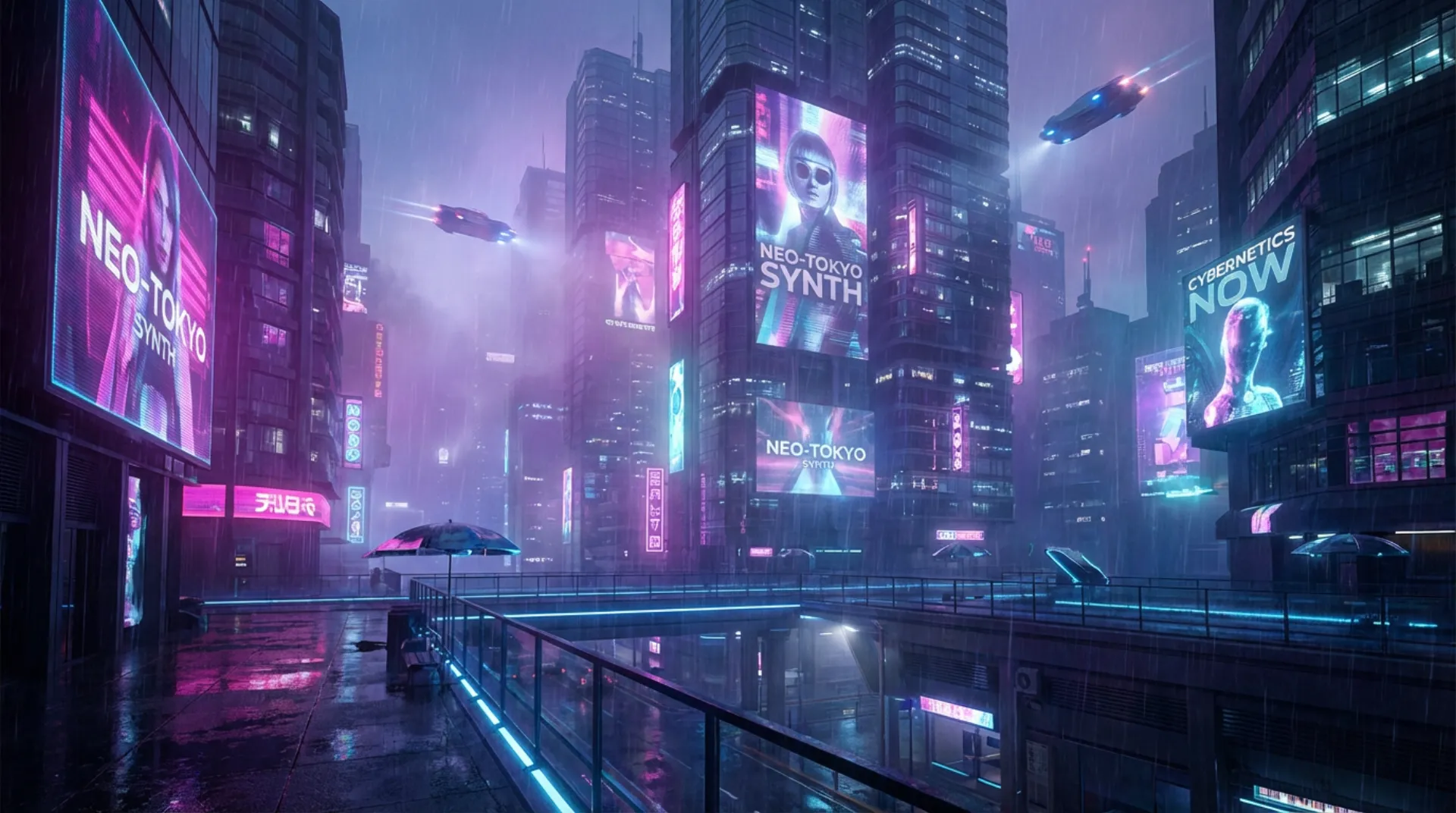
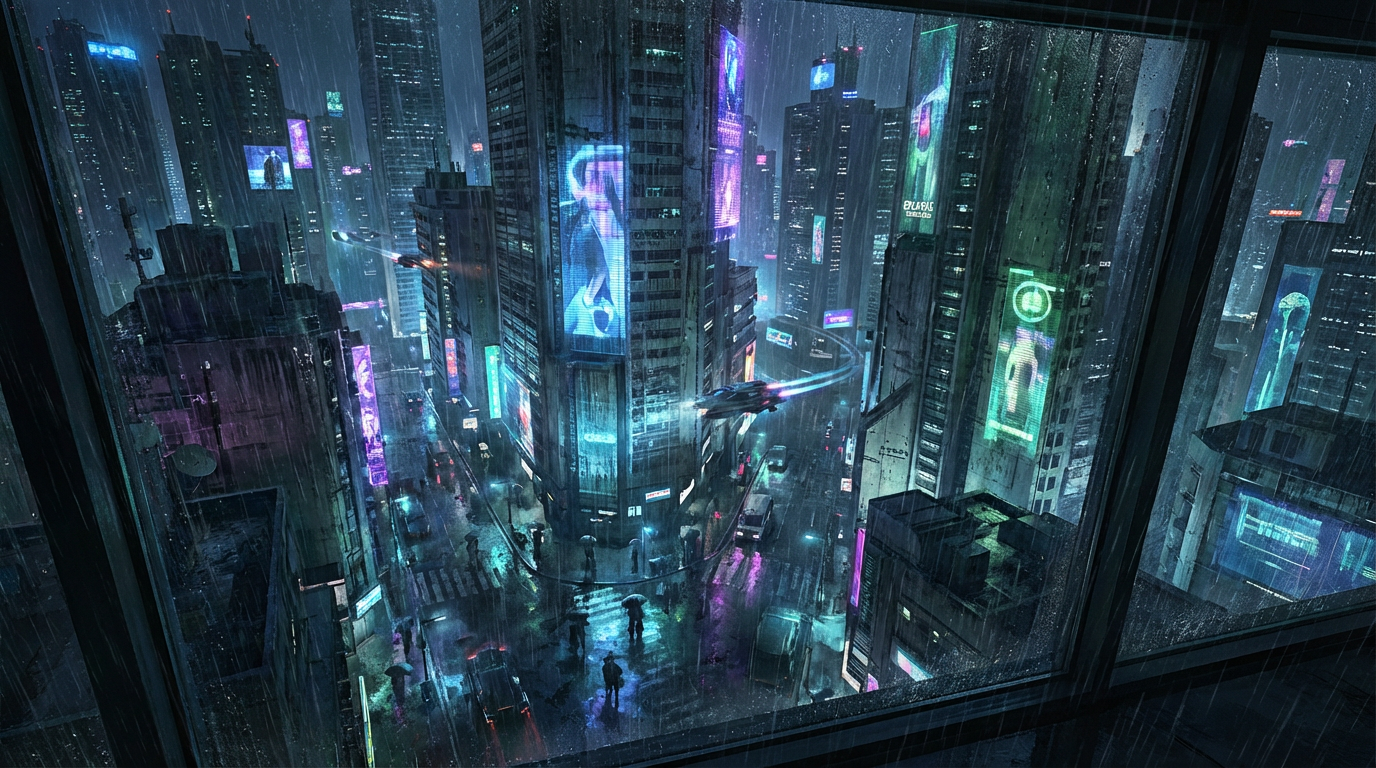
But when you put on headphones and hear the hum of a futuristic city, the distant sirens of flying cars, and the heavy, synthetic bass of a dystopian soundtrack, your brain switches context. You're no longer "fixing a typo in the JSON file." You are "recalibrating the neural network interface."
This is what psychologists call "Enclothed Cognition" – but for your ears. Just as wearing a lab coat makes people more attentive, "wearing" a cool soundscape makes you feel more competent, focused, and yes, like a badass hacker from a 90s movie. And confidence actually improves performance.
The Science: Why "Dark" Sounds Create Bright Focus
It sounds contradictory: Why would "dystopian" (i.e., depressing/oppressive) music help us focus? Shouldn't we be listening to happy birds chirping?
Actually, no. For deep cognitive work like coding, "happy" music can be distracting because it demands emotional engagement. Dystopian ambient music, on the other hand, shares key characteristics with Pink Noise and Brown Noise:
- Consistent Low Frequencies: The heavy, rumbling basses often found in sci-fi ambient (like massive ship engines or distant city hums) mask sudden background noises in your real environment.
- No Lyrics, No Melodies: Good dystopian ambient doesn't have a catchy chorus. It's a texture. It occupies the part of your brain that would otherwise get bored, without stealing resources from the part that's trying to understand recursion.
- The "Safe Space" Paradox: Evolutionarily, rain and storms signaled to our ancestors: "Stay in the cave, it's dangerous outside." This triggers a cozy, focused state indoors. Cyberpunk rain effects do exactly the same – they signal to your brain: "The world out there is chaotic and rainy. Stay here, in your IDE. It's safe."
My Newest Experiment: The Post-Apocalyptic Cyborg
I recently uploaded a new video to my Cyber Dreams channel that was specifically designed for this "Coding Flow" state. It's called "Post-Apocalyptic Cyborg".
I didn't just want "rain sounds." I wanted the feeling of being a machine that has survived the end of the world and is now just... functioning. Efficiently. Calmly.
The soundscape features:
- Heavy, rhythmic machinery hums (to drive momentum).
- Digital artifacts and glitches (to keep the brain slightly alert but not distracted).
- A vast, empty reverb (to create a sense of isolation – perfect for deep work).
It's not "relaxing" in the traditional sense. It's "focus-inducing." It's the audio equivalent of a triple espresso in a dark room.
Conclusion: Embrace the Dystopia
So, the next time someone asks why you're listening to "depressing robot noises," just tell them you're optimizing your cognitive throughput via psycho-acoustic masking. Or just tell them you're hacking the Gibson.
If you want to try it out, check out the new video on my channel. Put on your noise-canceling headphones, switch your IDE to high-contrast mode, and enter the Matrix.
Happy Coding. 🕶️
🎧 Listen While You Read
From our channel: Cyber Dreams
Megacity Rain Mode - Cyberpunk Ambient for Coding Nights & Focus
TAGS
Share this article