There is a particular kind of tiredness that arrives around dinner time. You have made it through work, messages, errands, and at least one small administrative mystery. You finally sit down to eat, but your brain is still standing in a brightly lit office holding a laptop and asking whether anyone replied to that email.
That is why an ordinary dinner can feel strangely rushed even when nobody is actually rushing. The food is there. The chair is there. Another person might even be there. But the day is still sitting at the table too, scrolling quietly under the napkin.
A romantic dinner at home is not a miniature restaurant. It does not need twelve candles, a menu written in handwriting that looks suspiciously like a ransom note, or a recipe involving a kitchen torch. It needs a short transition: a few choices that tell your attention that the useful part of the day is over and the human part is allowed to begin.
That is where soft piano ambience earns its place. Not as magic. Not as a cure for an overflowing inbox. Just as a reliable way to give the room a slower, warmer starting point.
What restaurant research can — and cannot — tell your living room
There is a useful fact behind the instinct to choose calmer music for dinner. In a 2024 field experiment with 282 tables of one or two adults, guests exposed to slow-tempo background music spent more time in the restaurant than guests exposed to fast-tempo music. The average was 80.3 minutes with slow music and 57.3 minutes with fast music. That is a result from one restaurant setting, not a laboratory-certified command to turn your dining room into an Italian trattoria. But it does support a modest idea: tempo can change how quickly people move through a meal.1
At home, that matters because the goal is not to manufacture romance by force. The goal is to remove a little unnecessary speed. If the music has no lyrics to compete with conversation, no heavy beat demanding applause, and no volume that turns “How was your day?” into a hostage negotiation, it can sit in the background and do exactly that.
The best test is wonderfully unscientific: can you both speak at normal volume without leaning across the table like detectives in a very loud café? If yes, the volume is probably doing its job. If not, the playlist has accidentally been promoted from atmosphere to main character.
The ten-minute landing strip
The reset starts before the food is served. Put the phones somewhere that is mildly inconvenient to reach. Not across the room with a security guard. Just far enough away that opening a social app becomes a conscious decision rather than a thumb reflex. Light one lamp instead of every available ceiling light. Set out the food. Then press play before you sit down.
This sequence is deliberately simple. It does not claim to fix every stressful day; a plate of pasta cannot negotiate with your calendar. It gives the evening a clear beginning. When the same small sequence is repeated, the cues become familiar: table, lower light, piano, sit down. Familiar cues make it easier to notice that you are no longer required to optimise anything for the next half hour.
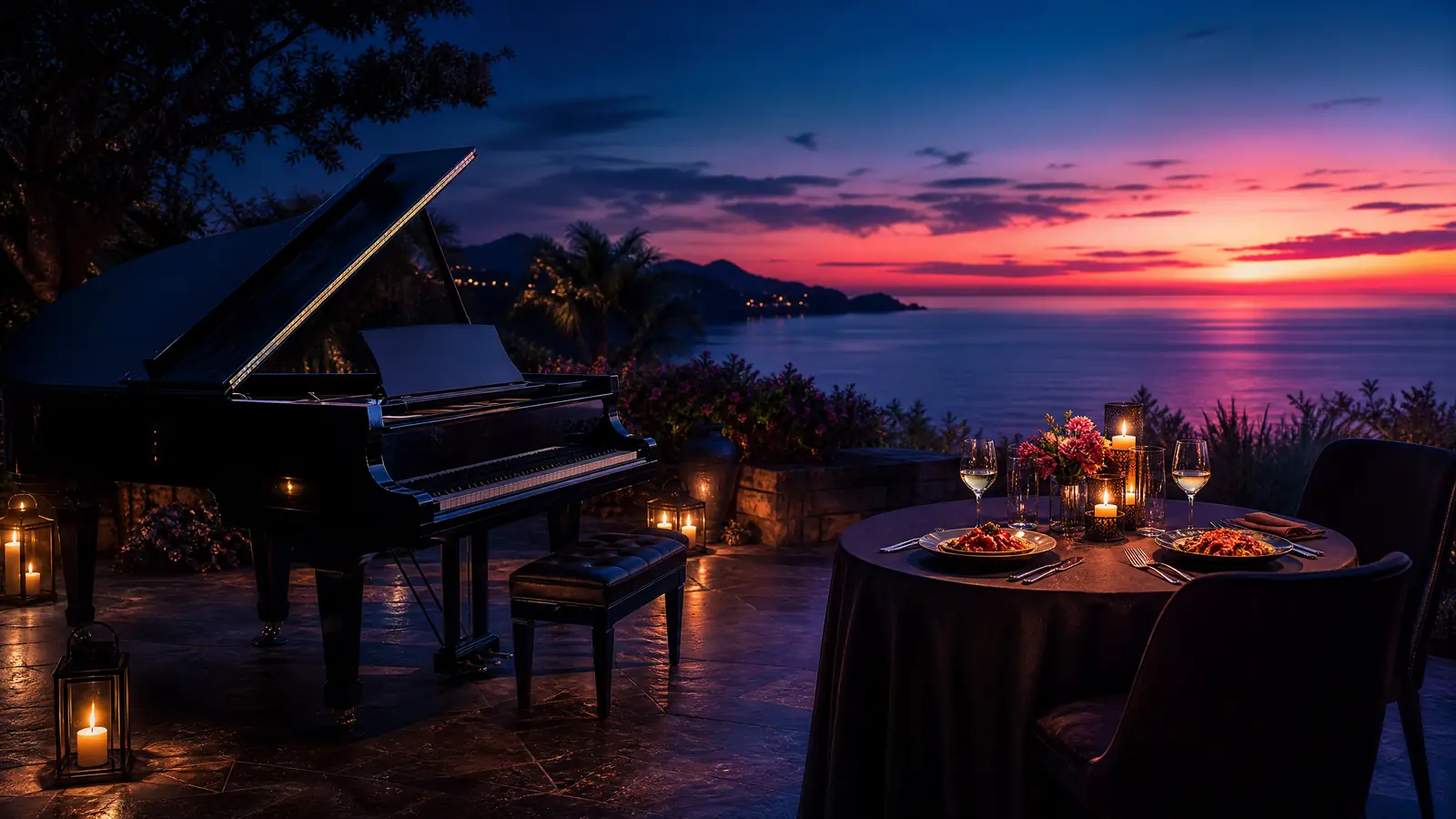
Seaside Evening Piano Ambience was made for that first ten-minute landing strip. Its warm piano, candlelit visual world and seaside-evening mood work best when the room is allowed to be ordinary. You do not need an actual coast. You need dinner, a chair, and the radical decision not to inspect tomorrow’s to-do list between two bites.
Why piano belongs behind the conversation
Piano ambience is useful for a shared dinner because it can add texture without asking everyone to follow a chorus. A familiar vocal can be lovely, but lyrics ask the language part of the brain to pay attention. That is not a flaw; it is the whole point of a good song. During dinner, however, the people at the table may deserve to be the words worth hearing.
Soft instrumental music gives the room a shape while leaving space inside it. The notes provide continuity when there is a quiet moment, which can make silence feel intentional rather than awkward. That does not mean every pause must be filled. A good pause is one of the luxuries of being at home. It means nobody has to scramble for their phone simply because the conversation took a breath.
As someone who spent years learning classical piano, I used to associate piano music with performance: correct notes, timing, concentration, and the possibility that a teacher would appear from behind a curtain to mention my left hand. Ambient piano changed that feeling for me. It can be precise without being demanding. It can be emotional without insisting that everybody announce their emotions over the salad.
Give the room one job
The room does not need to become impressive. It needs one clear job: make it easier to pay attention to dinner instead of the machinery of the day. That is why the smallest choices often matter more than expensive ones. Put the serving dish on the table rather than eating from the container. Use a glass you actually like. Leave the kitchen until later unless something is genuinely on fire. A little visible mess is not a failure of ambience; it is evidence that humans live here.
The same goes for the music. Do not hunt for a track that proves you have excellent taste. Choose something steady enough to leave alone. Long-form piano ambience is particularly useful because it removes the next-decision problem. You are not wondering what plays after the next song, and nobody has to reach for the remote halfway through a sentence. The evening gets to keep its momentum, which is far more romantic than pausing dinner to debate whether the algorithm has misunderstood your soul.
If you live with children, roommates, or neighbours who regard silence as a personal insult, the ritual can still work. It does not require perfect quiet. It only requires a small pocket of attention: one meal, softer light, lower volume, and the decision to let the rest of the household be imperfect for thirty minutes. That is not luxury. That is basic evening maintenance.
The middle twenty minutes: keep it human, not perfect
Once you are eating, resist the urge to turn the ritual into a project. You do not need a dress code. You do not need a three-course meal. You definitely do not need to say, “Now we are having a meaningful connection moment,” because that sentence has never made a moment more meaningful.
Instead, keep the evening small. Ask a question that has an answer longer than “fine.” Share one thing from the day that was better than expected. Let the conversation wander if it wants to. If you are having dinner alone, use the same time differently: eat without a second screen, notice the music, and allow the room to be quiet enough that your own thoughts are not competing with a video essay about productivity.
The practical rule is simple: do one thing at a time. Eat dinner. Listen softly. Speak if you are with someone. The moment becomes calmer not because the piano is performing a neurological miracle in the corner, but because there is less competition for your attention.
Choose atmosphere, not a soundtrack audition
A dinner playlist does not need constant change. In fact, the less you have to manage it, the better. Searching for the next perfect song every four minutes is just DJ work wearing a candle. Choose one long-form piano video, set the volume once, and leave it alone.
That is why long-form ambience videos are useful. They remove the tiny decisions that can keep a tired brain in work mode: What should I play next? Is this too energetic? Why did the algorithm just recommend an eighties power ballad? The answer can simply be: press play once and let the room settle.
The image in this video helps too, but it is optional. If the screen makes you want to check notifications, turn it away or use audio only. The music is the ritual; the visual is a bonus. Romance has survived for a very long time without a television pointed directly at the mashed potatoes.
A dinner reset is not only for date night
The word “romantic” can make people imagine expensive wine, immaculate shirts, and a table so polished that eating feels legally risky. Ignore that version. A romantic dinner can be two people recovering from Tuesday. It can be a solo meal where you decide you deserve more than standing at the counter. It can be leftovers, soup, pizza, or anything else that does not require a food stylist.
What matters is the intention: create a short space in which the day is not allowed to speak first. Piano music will not transform a difficult week. It can make the next thirty minutes gentler, and that is already useful.
Try it tonight. Prepare the simplest dinner you genuinely want to eat. Lower one light. Put your phone out of reach. Start Seaside Evening Piano Ambience from Pianosphere Radio. Then let dinner be dinner: no performance, no scrolling, no urgency. Just food, soft piano, and enough room for the evening to finally arrive.
Footnotes
-
Malcman, M., Azar, O. H., Shavit, T., & Rosenboim, M. (2024). How Does Background Music Affect Dining Duration, Tips and Bill Amounts in Restaurants? A Field Experiment. Behavioral Sciences, 14(12), 1188. ↩
🎧 Listen While You Read
From our channel: Pianosphere Radio
Seaside Evening Piano Ambience | Romantic Dinner Music, Relaxation & Calm
TAGS
Share this article