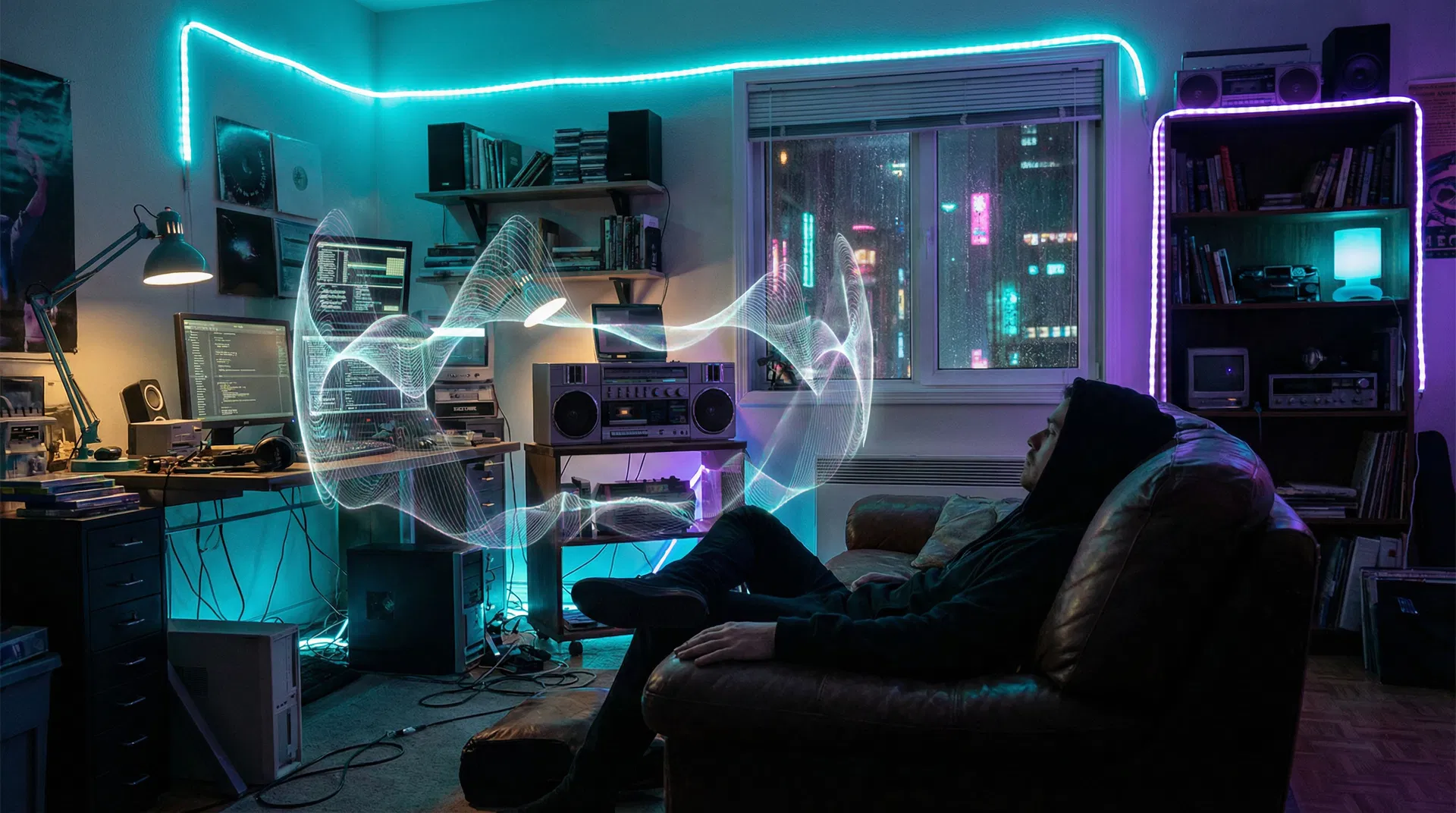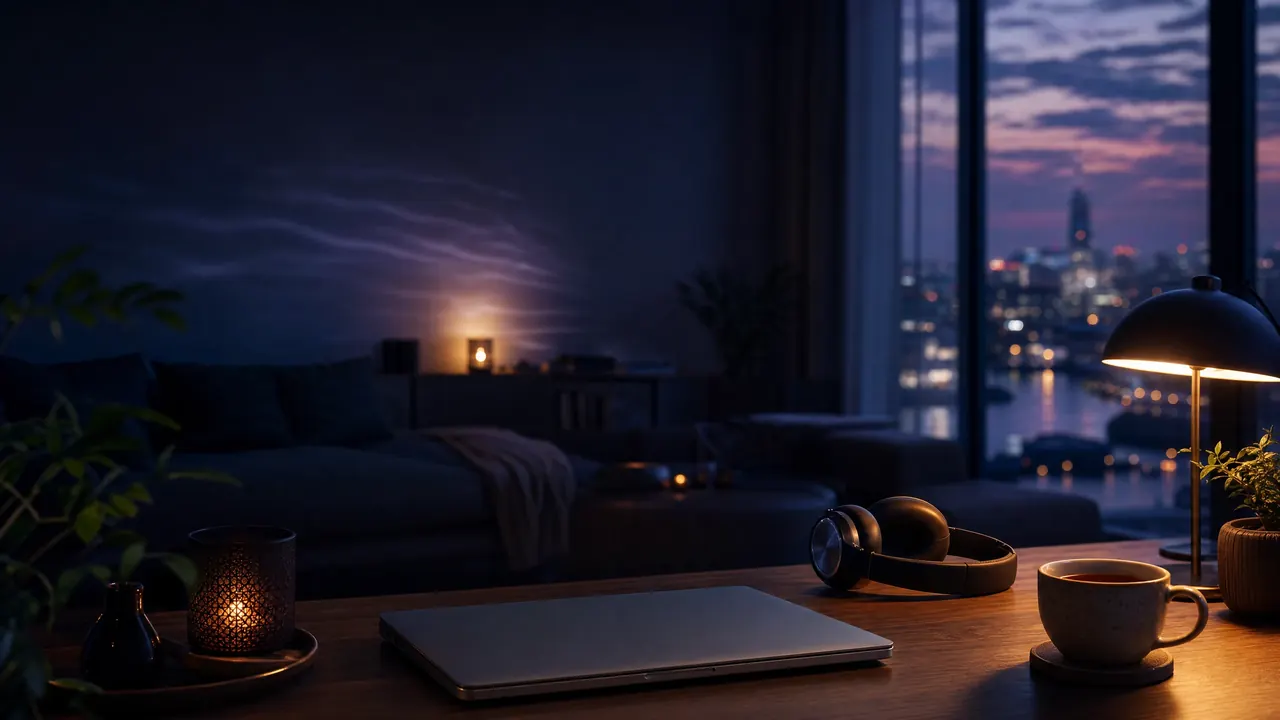
There is a very specific moment in the evening when the laptop closes, the chair rolls back, and your body technically leaves work.
Your brain, unfortunately, does not always attend the same meeting.
It is still somewhere in spreadsheet country, wearing a tiny headset, muttering about one more email, one more task, one more thing that could definitely wait until tomorrow but has decided to tap dance on your nervous system right now.
That is why the evening wind-down routine matters. Not because you need another productivity ritual with a complicated name and a notebook made from sustainable bamboo. You need it because the human nervous system is terrible at abrupt scene changes. Work does not end just because the screen goes dark. Your body needs a signal. Your mind needs a bridge. And ideally, that bridge should not be built out of phone scrolling and cold leftovers eaten while standing in front of the fridge like a raccoon with calendar anxiety.
Music is one of the easiest ways to create that bridge. It gives the brain something gentle to follow, the body a slower rhythm to mirror, and the evening a clear message: we are not solving problems now. We are landing.
Why Your Brain Refuses to Clock Out
Modern work is not heavy in the old physical sense. Most of us are not carrying stones up a mountain. We are carrying unread messages, decision fatigue, deadlines, notifications, and the emotional weight of pretending that a meeting called quick sync will actually be quick.
By the time the workday ends, your body may be sitting still, but your nervous system can still be running a full internal software update. The sympathetic nervous system, the part associated with alertness and stress response, does not switch off instantly. It needs cues that the environment is safe, the pressure is over, and no one is about to ask for a revised version of anything.
The problem is that many evening habits send the opposite signal. You close the laptop, then open the phone. You leave one glowing rectangle and immediately report for duty to a smaller glowing rectangle. Your brain sees this and thinks: excellent, more input. Shall we continue being mildly tense for another three hours?
This is how people end up physically on the couch but mentally still in the office. The body is horizontal. The mind is sending emails in a suit.
The Couch Trap
The couch looks innocent. Soft cushions, friendly blanket, maybe a pillow that says something optimistic like home or relax. But the couch can become a trap if you arrive there with the same mental speed you had five minutes after your last call.
If you sit down and immediately start scrolling, your nervous system does not receive a relaxation signal. It receives a slot machine. New image. New headline. New comment. New micro-outrage. New recipe you will never cook. New person doing yoga on a balcony at sunrise, which somehow makes you feel both inspired and personally attacked.
That is not rest. That is attention confetti.
The goal of a wind-down routine is not to make your evening perfect. Perfect evenings are suspicious. The goal is simply to create a repeatable transition between doing and being. You are training your body to recognize a pattern: work is finished, input is reduced, sound becomes slower, breathing becomes deeper, and the evening can finally stop wearing office shoes.
The 20-Minute Sound Bridge
A good wind-down routine does not need to be long. In fact, it works better when it is short enough that your brain cannot negotiate with it.
Twenty minutes is a useful starting point. It is long enough for the body to notice the shift, but short enough that you do not need to cancel your life, buy incense, or explain to your family that you have entered a monastery between 6:10 and 6:30 PM.
This is where music becomes practical. Slow, warm, low-pressure music gives your attention a place to rest without demanding analysis. You are not trying to appreciate every chord like a professor in a velvet jacket. You are letting the sound shape the room.
For this first phase, Chillout Sphere is the natural fit. Chillout soundscapes work well because they create atmosphere without turning into a performance. The music is present enough to soften the room, but not so busy that your brain starts taking notes. It is not trying to impress you. It is trying to help your shoulders remember gravity.
And yes, shoulders do forget gravity. Especially after a day of emails.
The Actual Evening Wind-Down Routine
Here is the simplest version I use and recommend. It is deliberately boring, because boring is underrated. Your nervous system does not need a fireworks display. It needs consistency.
First, close the laptop and make it physically unavailable. Not dramatically. No ceremonial farewell. Just close it, place it somewhere that is not within lazy arm distance, and let it stop being the center of the room. If your laptop is still glowing at you, your brain will treat it like an open door.
Second, dim the lights. Bright light tells the body to stay alert. Softer light tells it that the emergency department is closed for the evening. A lamp is enough. You do not need to live inside a candle commercial.
Third, put on headphones or let the music play quietly in the room. Start with Chillout Sphere for the first twenty minutes. Do not multitask. Do not check messages. Do not use the music as background for reorganizing your digital life. Just sit, breathe, and let the room change.
Fourth, slow your breathing without turning it into a sport. You do not need advanced breathwork. Just inhale a little slower than usual, exhale a little longer than usual, and repeat. If your brain interrupts with tomorrow's to-do list, gently return to the music. Your brain is not broken. It is just an overenthusiastic intern with access to your stress hormones.
Fifth, after twenty minutes, decide what the evening needs. If you still feel wired, continue with soft ambient or chillout. If you want something more intimate and emotionally grounded, move into Pianosphere Radio. Piano is excellent for the second phase of the evening because it feels human without being intrusive. It gives the mind a gentle emotional landing pad.
If you prefer warmth, texture, and the feeling of a quiet lounge where nobody asks you for quarterly numbers, JazzSphere Radio can also work beautifully. Jazz gives the evening a little candlelight without requiring actual candles, which is helpful if you are the kind of person who forgets where they put things.
Which Music Fits Which Evening Phase?
Not every relaxed track does the same job. The evening has phases, and matching the sound to the phase makes the routine feel natural instead of forced.
| Evening phase | Best musical fit | Why it helps |
|---|---|---|
| Right after work | Chillout Sphere | Soft textures and slow grooves create a clean transition away from work mode. |
| After dinner | JazzSphere Radio | Warm jazz creates comfort, room atmosphere, and a gentle social feeling without demanding attention. |
| Before sleep | Pianosphere Radio | Soft piano supports emotional grounding and reduces the need for visual stimulation. |
The trick is to avoid music that secretly keeps you activated. If the beat makes you want to clean the kitchen aggressively, answer emails, or suddenly reorganize your entire tax folder, it may be excellent music, but it is not wind-down music.
Evening music should not push you forward. It should invite you downward.
The Phone Rule Nobody Wants But Everybody Needs
Now for the unpleasant part: your phone is probably the main reason your evening does not feel like an evening.
This is not a moral judgment. Phones are useful. They are also tiny stress vending machines. You pick them up for the weather and somehow end up reading about a celebrity divorce, a new productivity method, and a man in another country who has built a house entirely out of mushrooms. Fifteen minutes later, your tea is cold and your nervous system has joined a debate it was never invited to.
During the first twenty minutes of the routine, the phone should be out of reach. Not necessarily in another building. Just far enough away that checking it requires intention. The goal is not digital purity. The goal is friction.
Friction is underrated. A phone on the table is an invitation. A phone across the room is a decision. Decisions are easier to win when they require standing up.
Why Repetition Works
A wind-down routine becomes more effective when it repeats. Your brain learns cues. Same time, same music, same lighting, same sequence. Eventually, the first notes become a signal. The shoulders drop sooner. The breathing slows faster. The body starts recognizing the pattern before the mind has finished complaining.
This is not magic. It is conditioning. You are teaching your nervous system a new association: evening music means safety, closure, and recovery. Over time, the routine becomes less something you do and more something your body understands.
That is why consistency matters more than intensity. One heroic two-hour relaxation session followed by six chaotic evenings will not do much. Fifteen to twenty minutes every day can change the texture of the week.
Think of it as brushing your teeth, but for your stress response. Less minty, more atmospheric.
A Simple Version for Tonight
Try this tonight before making it complicated.
Close the laptop. Put the phone somewhere annoying. Dim one lamp. Start Chillout Sphere. Sit for twenty minutes. Do not optimize it. Do not track it. Do not turn it into a self-improvement project with charts, badges, and a spreadsheet called Relaxation KPI Final Final v3.
Just listen.
After twenty minutes, notice what changed. Maybe your breathing is slower. Maybe your jaw is less tense. Maybe your mind is still busy, but less sharp around the edges. That counts. Relaxation is not always dramatic. Sometimes it arrives like a quiet guest who does not ring the doorbell because it knows you have had enough noise today.
The Point Is Not to Escape the Day
A good evening routine is not about pretending the day did not happen. It is about helping the day end properly.
Work needs closure. The body needs a downshift. The mind needs a softer place to land. Music helps because it does not argue with you. It does not ask for a password. It does not need a meeting invite. It simply changes the atmosphere and gives your nervous system a reason to stop bracing.
So tonight, do not fight your brain. Give it a better exit sign.
Close the laptop. Lower the light. Press play. Let the evening become an evening again.
TAGS
Share this article