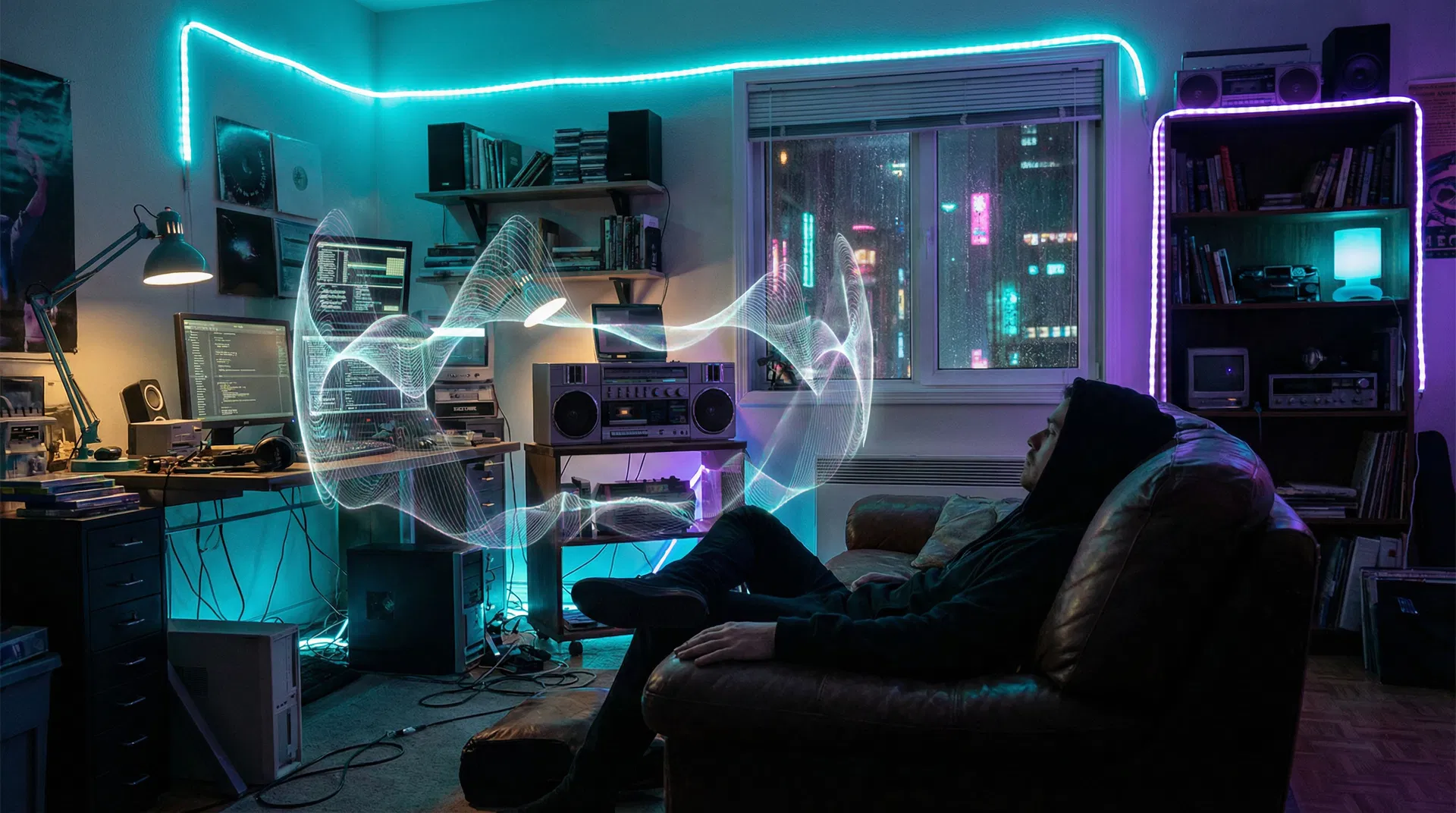
It's 6:00 PM. You've just closed your laptop after eight hours of Zoom calls, debugging code, and pretending to care about Q3 projections. You are physically sitting on your couch, but your brain is still running at 4,000 RPM. You try to relax by scrolling through Instagram, but it just makes you feel more wired. You try to sit in silence, but your inner monologue starts listing all the things you forgot to do today.
Welcome to the "Zombie Mode." You're too tired to work, but too wired to rest.
Most people try to fix this by "numbing out" (Netflix, wine, doomscrolling). But numbing isn't resting. To actually recover, you need to actively switch your nervous system from Sympathetic (Fight or Flight) to Parasympathetic (Rest and Digest).
And the fastest way to flip that switch isn't silence. It's sound.
Why Silence Can Backfire
When you're in a high-stress state, your brain is flooded with cortisol. If you suddenly drop into total silence, your brain perceives this as a "void" and rushes to fill it with thoughts. This is why meditation is so hard when you're stressed.
As we discussed in our article on Why People Relax Wrong, effective relaxation requires a bridge. You need a sensory input that is safe, predictable, and immersive to guide your brain down from the cliff.
The 20-Minute Reset Routine
I developed this routine for myself after years of late-night editing sessions. It uses the principles of "frequency following response" to physically slow down your brainwaves.
Step 1: The "Wash Cycle" (Minutes 0-5)
Goal: Drown out the inner monologue.
Sound: Heavy Rain or Ocean Waves (Pink Noise).
Why: You need a broad-spectrum sound that occupies the full frequency range. This acts like a "sonic shower," masking distracting thoughts and creating a boundary between "work time" and "me time."
Recommended Channel: Deep Focus (yes, it works for relaxing too).
Step 2: The "Drift" (Minutes 5-15)
Goal: Lower heart rate and loosen muscles.
Sound: Slow, ambient pads with no melody.
Why: Now that the noise in your head has quieted, you need to signal safety to your body. Long, sustained musical notes (drones) mimic the human breath. If the music breathes slowly, you breathe slowly.
Recommended Channel: Chillout Sphere.
Step 3: The "Return" (Minutes 15-20)
Goal: Re-enter reality with clarity.
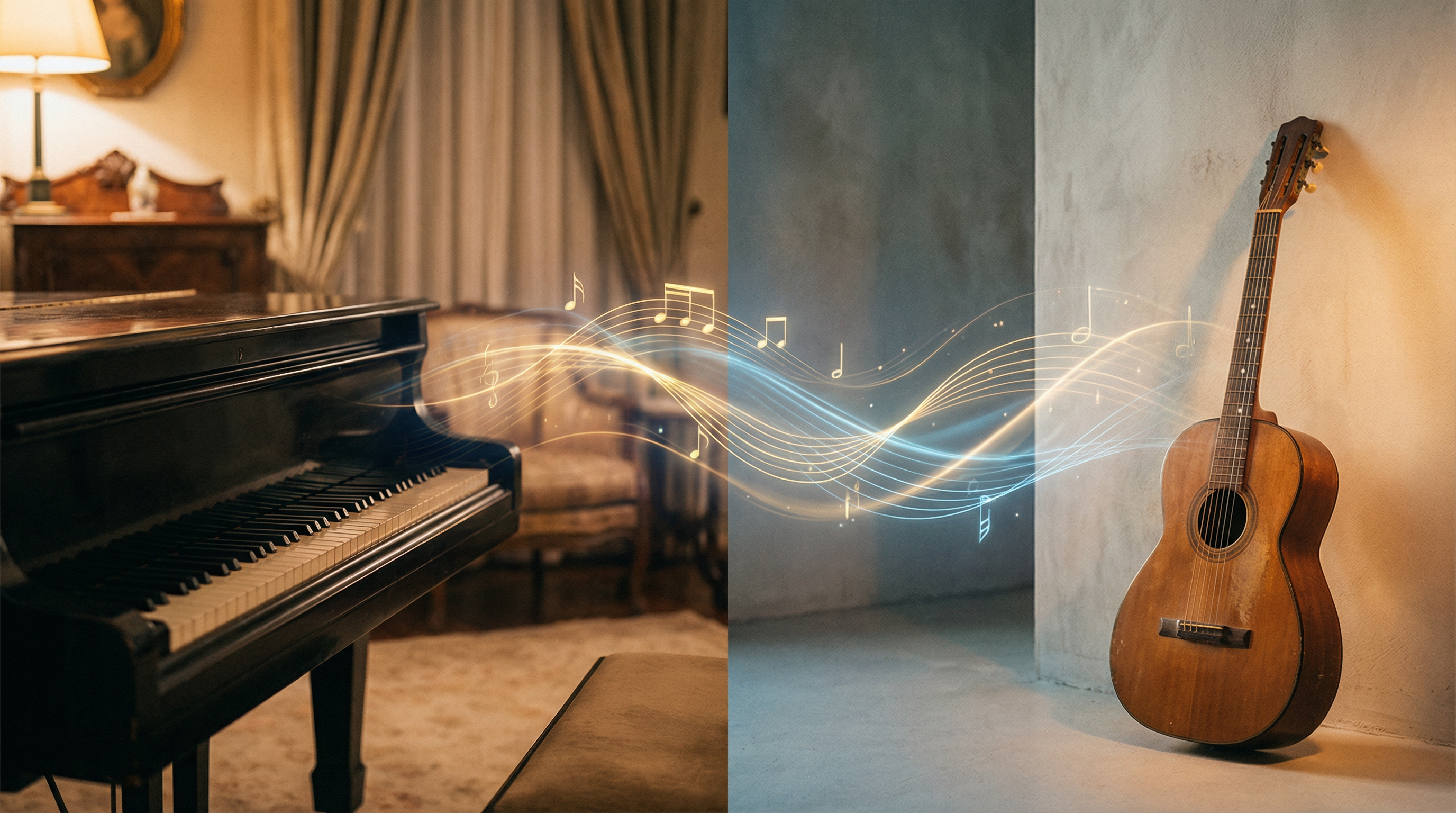
Sound: Gentle piano or acoustic guitar.
Why: You don't want to stay in a trance forever. Introducing a gentle melody wakes up your emotional center and prepares you to interact with your family or make dinner, feeling refreshed rather than drained.
Recommended Channel: Pianosphere.
The Science of the "Switch"
This isn't magic; it's biology. Your auditory cortex is directly wired to your amygdala (the fear center). By feeding it "safe" sounds—nature, harmony, slow tempos—you are manually hacking your body's stress response.
Think of it like a cool-down lap after a sprint. You wouldn't stop dead after running a marathon; you'd walk it off. Your brain needs the same courtesy.
Try the Reset Tonight
Don't wait until you're burned out. Make this 20-minute sonic bath a ritual. Put on your headphones, close your eyes, and let the sound do the heavy lifting.
Start Your Reset🎧 Listen While You Read
From our channel: Chillout Sphere
Rooftop Serenity - 3 Hours of Smooth Chillout & Lounge Music for Unwinding
TAGS
Share this article