Last Tuesday, I had a panic attack in the middle of a grocery store. Nothing dramatic triggered it. I was just standing in the cereal aisle when my heart started racing, my hands went numb, and suddenly I couldn't remember why I was there or how to get out.
I've dealt with anxiety for years. I know the drill. But here's what's interesting: When I got home and tried to calm down, I instinctively reached for my guitar instead of sitting at my piano.
This surprised me. I'm a trained pianist. I spent a decade learning classical repertoire. I've built an entire music channel around piano compositions. By all logic, piano should be my go-to anxiety relief tool.
But in that moment, my brain wanted the guitar. And it worked.
That experience made me realize something I'd never consciously thought about before: Different instruments work better for different types of anxiety. Not because one is objectively "better," but because anxiety itself isn't one single thing.
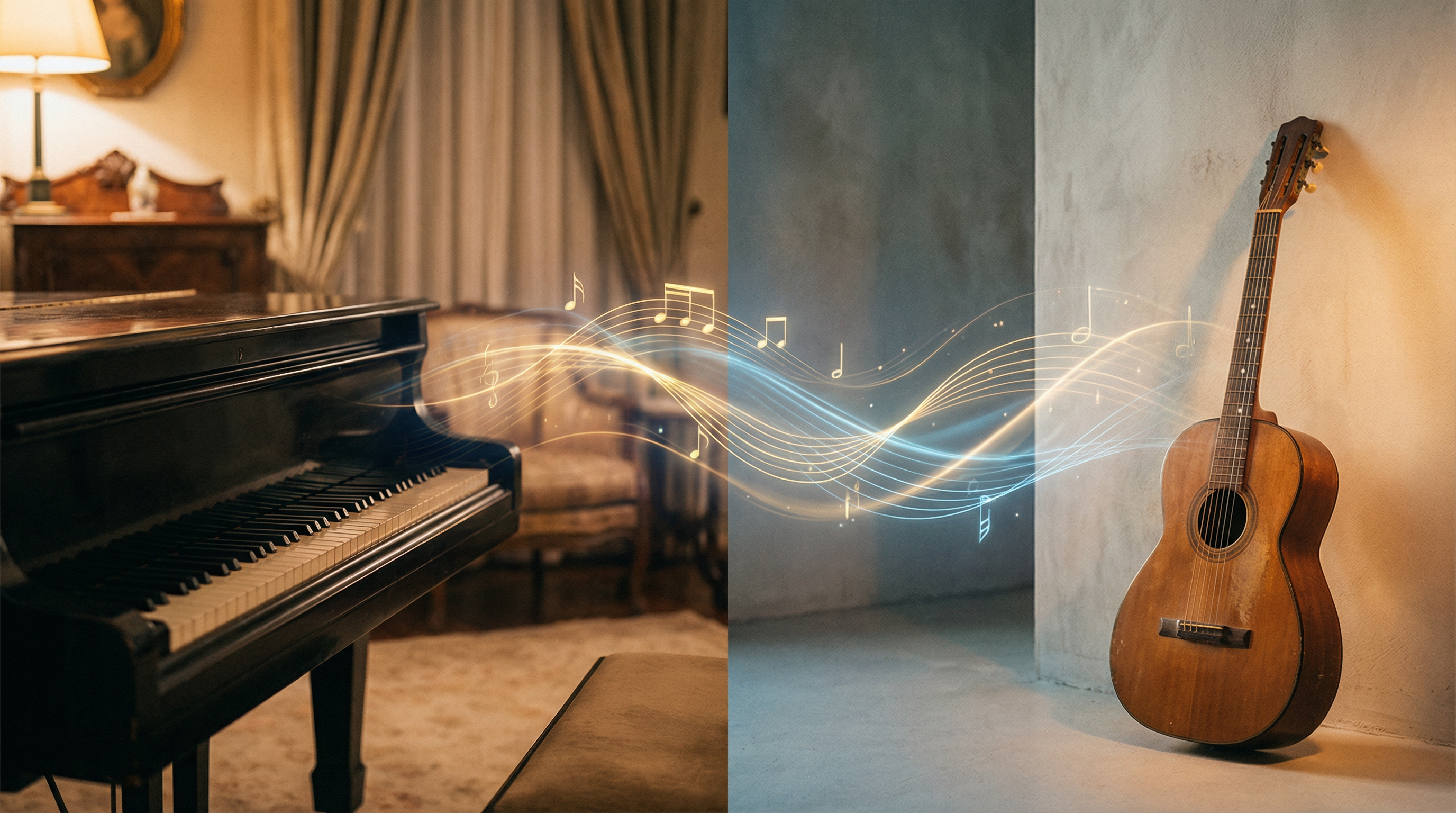
So let me share what I've learned from both scientific research and a frankly embarrassing amount of personal experimentation about when piano works better, when guitar wins, and why the answer might surprise you.
The Anxiety Epidemic Nobody Talks About Properly
Before we dive into instruments, let's get something straight: Anxiety disorders are now the most common mental health condition globally, affecting an estimated 301 million people according to the World Health Organization. That's not just "feeling stressed." That's clinical-level interference with daily life.
And here's the part that frustrates me: Most anxiety advice treats it like it's one monolithic thing. "Try meditation!" "Exercise more!" "Listen to calming music!" These suggestions aren't wrong, but they're incomplete because they ignore a crucial fact.
Anxiety manifests differently in different people. For some, it's racing thoughts that won't shut up. For others, it's physical symptoms like a pounding heart and sweaty palms. Some people experience social anxiety that makes every interaction feel like a performance. Others have generalized anxiety that colors everything with a vague sense of dread.
The type of anxiety you have matters because it determines what kind of intervention actually helps. And yes, that includes which musical instrument provides the most relief.
What Science Actually Says About Music and Anxiety
Let me start with the hard facts before I give you my opinions. A 2022 systematic review and meta-analysis published in Health Psychology Review analyzed multiple studies on music therapy for stress reduction. The researchers found that music interventions significantly reduced physiological stress markers including cortisol levels, heart rate, and blood pressure.
But here's the interesting part that most articles skip: Not all music works equally well for all people. The same review noted that individual preferences and the specific characteristics of the music both played crucial roles in effectiveness.
Another study published in Psychiatry Research in 2021 specifically examined music therapy for anxiety and found significant improvements across clinical settings. However, the researchers emphasized that the therapeutic effect depended heavily on matching the music characteristics to the individual's needs.
Translation: The science confirms that music helps with anxiety, but it also confirms what my grocery store panic attack taught me. There's no universal "best" music for anxiety because there's no universal anxiety experience.
So let's break down the two instruments I know best and examine when each one actually works.
The Piano Case: When Structure Saves You
I'm going to start with piano because it's what I know most intimately. Ten years of classical training means I understand this instrument not just as a listener but as someone who's lived inside its harmonic world.
Piano music has a particular quality that I think of as "architectural." When you listen to piano, even simple ambient piano, you're hearing a complete harmonic structure. The left hand typically provides bass notes and harmonic foundation while the right hand carries melody. It's like listening to a building being constructed in real-time, each note adding to a stable structure.
This architectural quality is why piano works exceptionally well for what I call "cognitive anxiety." That's the type of anxiety where your thoughts are racing, spiraling, catastrophizing. Your brain is generating worst-case scenarios faster than you can process them, and you feel like you're losing control of your own mind.
Here's what I've observed both personally and through conversations with others who use music for anxiety management: Piano music provides a structured sonic environment that gives your racing mind something stable to latch onto. The predictable harmonic progressions, the clear melodic lines, the rhythmic consistency all create a framework that your anxious brain can use as an anchor.
There's a reason why so many sleep playlists feature solo piano. The instrument's sustain pedal allows notes to blend together, creating a continuous wash of sound without jarring interruptions. When you're lying in bed at 3 AM with your mind racing through tomorrow's meetings and next month's bills and that embarrassing thing you said five years ago, piano music provides a gentle but persistent alternative focus point.
I've also noticed that piano music works particularly well for insomnia-related anxiety. That specific flavor of anxiety where you're exhausted but your brain won't shut off. The combination of harmonic completeness and gentle repetition seems to satisfy the brain's need for stimulation while simultaneously not being stimulating enough to keep you awake.
But piano has limitations. And this is where my training actually became a problem rather than a solution.
The Piano Paradox: When Perfection Backfires
Remember how I said I instinctively reached for guitar after my panic attack instead of piano? Let me explain why.
Piano music, especially well-performed piano music, can feel almost too perfect. Every note is precisely placed. The dynamics are carefully controlled. The harmonic progressions follow established patterns. For someone with musical training, this perfection can actually increase anxiety rather than reduce it.
Here's what happens in my brain when I'm anxious and I listen to complex piano music: I start analyzing it. Even though I'm not trying to, my trained musician brain begins following the harmonic progressions, anticipating the melodic resolutions, noticing the technical choices. It's like trying to relax by watching a movie in a language you're currently learning. Your brain keeps trying to translate instead of just experiencing.
This is why I've learned to be very selective about piano music for anxiety relief. Simple ambient piano works beautifully. Piano Lounge – Relaxing Piano Music is a perfect example of this approach. But complex classical pieces, even beautiful ones, can actually make my anxiety worse because they demand too much cognitive engagement.
There's also something about the piano's percussive attack that doesn't always work for acute anxiety. Each note has a distinct beginning, a small percussive moment when the hammer hits the string. For some types of anxiety, especially the kind accompanied by hypervigilance or startle responses, these small percussive moments can feel jarring rather than soothing.
This is where guitar enters the picture with a completely different sonic personality.
The Guitar Advantage: Warmth Over Structure
Guitar music feels fundamentally different from piano music, and I don't just mean in terms of timbre. The difference goes deeper into how the instruments produce sound and what that means for your nervous system.
When you pluck a guitar string, the sound doesn't have that percussive attack of a piano hammer. Instead, you get this organic, gradually emerging tone that feels more like a breath than a strike. The sound swells, sustains, and fades in a way that mirrors natural breathing patterns.
I've noticed that guitar music works exceptionally well for what I call "somatic anxiety." That's the type of anxiety that lives in your body rather than your thoughts. Racing heart. Tight chest. Shallow breathing. Trembling hands. The physical manifestations of anxiety that make you feel like your body has betrayed you.
Guitar music, particularly acoustic guitar, seems to speak directly to the nervous system in a way that bypasses cognitive processing. The warm, mid-range frequencies of a guitar occupy a sonic space that feels inherently comforting. It's the frequency range of the human voice, of a crackling fire, of rain on leaves. Our brains are evolutionarily wired to find these frequencies safe and soothing.
There's also a cultural component that I think matters more than we acknowledge. Guitar has associations with intimacy and human connection in a way that piano doesn't. Think about it: guitars appear around campfires, in small coffee shops, in living rooms during family gatherings. Piano appears in concert halls, churches, formal recitals. Both are beautiful, but they carry different emotional associations.
When I'm experiencing social anxiety, the kind where I feel isolated and disconnected from other humans, guitar music provides a sense of companionship that piano music doesn't quite achieve. It feels less like listening to a performance and more like sitting with a friend who doesn't require you to talk.
The Surprising Verdict: It Depends On Your Anxiety Type
So which instrument is better for anxiety relief? Here's my honest answer after years of both classical training and personal experimentation: It depends entirely on what type of anxiety you're experiencing.
If your anxiety manifests as racing thoughts, catastrophic thinking, or mental spiraling, piano music provides the structured sonic environment that can help anchor your mind. The harmonic completeness and predictable patterns give your brain something stable to focus on instead of its own anxious narratives.
If your anxiety lives primarily in your body with symptoms like rapid heartbeat, shallow breathing, or physical tension, guitar music's organic quality and breathing-like phrasing can help regulate your nervous system more effectively than piano's more structured approach.
If you're dealing with social anxiety or feelings of isolation, guitar music's intimate, human quality often provides more comfort than piano's more formal presence.
If you're experiencing performance anxiety or imposter syndrome, guitar might actually work better than piano specifically because it doesn't carry the same associations with formal achievement and technical perfection.
And if you're dealing with panic attacks or acute anxiety episodes, you might find that neither piano nor guitar works as well as pure ambient soundscapes without distinct melodic instruments at all. Sometimes the brain needs even less structure, not more.
Building Your Personal Anxiety Relief Toolkit
Here's what I've learned about using music effectively for anxiety management: You need options. Relying on a single type of music is like having only one tool in your toolkit. Sometimes you need a hammer, sometimes you need a screwdriver, and sometimes you need something else entirely.
I keep different playlists for different types of anxiety episodes. When I'm lying awake at night with racing thoughts, I reach for simple ambient piano. When I'm feeling physically anxious and disconnected, I choose acoustic guitar. When I'm having a full-blown panic attack, I skip both instruments and go straight to pure ambient soundscapes or binaural beats.
The key is learning to recognize what type of anxiety you're experiencing in the moment and matching it to the appropriate musical intervention. This takes practice and honest self-observation. You have to pay attention not just to whether music "helps" but specifically how it helps and under what circumstances.
I also recommend experimenting with tempo. Research has shown that music with a tempo around 60 beats per minute can help synchronize your heart rate to a calmer rhythm. Both piano and guitar music can be found at this tempo, but the effect feels different depending on the instrument. Piano at 60 BPM feels meditative and structured. Guitar at 60 BPM feels more like a gentle rocking motion.
Volume matters too, and this is something I got wrong for years. I used to think anxiety relief music should be barely audible, like sonic wallpaper. But I've found that moderate volume often works better because it gives your brain enough sensory input to focus on without being overwhelming. Too quiet and your anxious thoughts can still dominate. Too loud and it becomes another source of stress.
Beyond Piano and Guitar: The Full Spectrum
I've focused on piano and guitar because those are the instruments I know most intimately, but honesty requires me to acknowledge that sometimes neither works optimally. Sometimes you need jazz with its sophisticated harmonies and conversational quality. Sometimes you need pure ambient music without distinct instruments. Sometimes you need binaural beats or nature sounds or complete silence.
The broader lesson here is about matching the intervention to the specific problem rather than assuming one solution works for everything. This applies not just to music but to anxiety management in general.
Medication works for some people and not others. Therapy comes in many forms because different approaches work for different individuals. Exercise helps many people but can actually increase anxiety for others. Meditation is powerful for some and frustrating for others.
Music is the same. It's a tool, not a cure. And like any tool, its effectiveness depends on using the right one for the right job.
The Best Instrument Is the One You'll Actually Use
Here's my final piece of advice, and it's probably the most important: The best instrument for your anxiety relief is whichever one you'll actually listen to consistently.
All the scientific research and personal experimentation in the world doesn't matter if you don't actually use the tool. If you hate piano music, it doesn't matter that it might theoretically work better for your type of anxiety. If guitar music resonates with you emotionally, that emotional connection is itself therapeutic regardless of the technical characteristics of the instrument.
I've spent this entire article analyzing the differences between piano and guitar for anxiety relief, but the truth is that your subjective response matters more than any objective analysis. If something works for you, even if it "shouldn't" work according to theory, then it works. Trust your own experience.
That said, I do encourage you to experiment beyond your default preferences. I never would have discovered guitar's effectiveness for my physical anxiety symptoms if I hadn't been willing to try something other than my familiar piano comfort zone. Sometimes the thing that works best is the thing you haven't tried yet.
Where to Start
If you want to experiment with piano music for anxiety relief, start with simple ambient piano rather than complex classical pieces. Look for music with minimal harmonic movement, gentle dynamics, and a tempo around 60-70 beats per minute. Piano Lounge – Relaxing Piano Music is an excellent starting point.
For guitar music, seek out acoustic fingerstyle guitar or classical guitar pieces with warm, resonant tones. Avoid guitar music with percussion or complex rhythmic patterns if you're dealing with acute anxiety. The simpler and more spacious, the better.
And remember: Music is a complement to professional mental health care, not a replacement for it. If you're struggling with anxiety that interferes with your daily life, please talk to a qualified mental health professional. Music can be a beautiful tool in your anxiety management toolkit, but it's not a substitute for proper treatment.
The grocery store panic attack I mentioned at the beginning? It passed. The guitar music helped. But what helped more was having a therapist I could call, medication that works for me, and years of learning to recognize my anxiety patterns and respond to them appropriately.
Music is part of that response. Sometimes it's piano. Sometimes it's guitar. Sometimes it's neither. The key is having options and the self-awareness to choose the right one for the moment you're in.
And if you're reading this because you're struggling with anxiety right now, I want you to know: You're not alone. The fact that you're researching ways to manage your anxiety shows strength, not weakness. Keep experimenting. Keep learning what works for you. And be patient with yourself in the process.
Your brain is doing its best to protect you, even when that protection manifests as anxiety. Sometimes the kindest thing you can do is give it some beautiful music to focus on instead of its own worried narratives. Whether that music comes from a piano, a guitar, or something else entirely doesn't matter nearly as much as the fact that you're taking care of yourself.
That's what really matters.
🎧 Listen While You Read
From our channel: Pianosphere Radio
Moody Piano Ballads – Atmospheric Background Music for Unwinding
TAGS
Share this article